Saturday, 19 July 2008

Site 10: The Shakespeare Centre Library and Archive

July 18, 2008


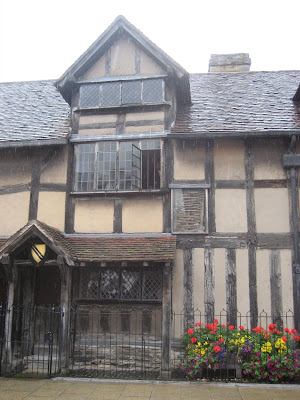
(Shakespeare's home)
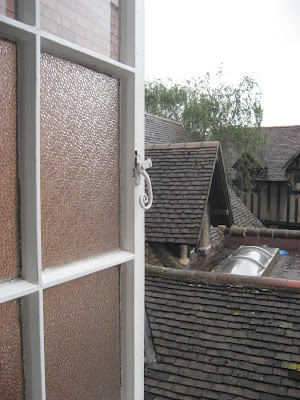

(The rooftops of Stratford upon Avon)

Stratford is what I certainly think of -- or thought, I'm beginning to alter my impressions daily -- when England came to mind: quaint, with wooden houses lining a river, bright flowers hanging over sidewalk signs, and a hint of rain always hovering. Its ever-present dreariness overpowered by the cheer in architecture and gardens. I'm sure it wasn't quite so charming in Shakespeare's time, not in the sense that it looks postcard ready at all times. But if there's one thing that might've remained from the 16th century, it's this: a circle of people weaving out of a pub, one, maybe two of them pausing, starting, and then, puking out his guts. Welcome to Stratford-Upon-Avon. It's almost four in the afternoon.

Not that I'm casting generalizations about town. It's just that after viewing the library, which was amazing, amazing, amazing -- returning outside to rain and vomit, it's pretty much a let down. So I'm going to return indoors, back to the library, where I should've started in the first place.
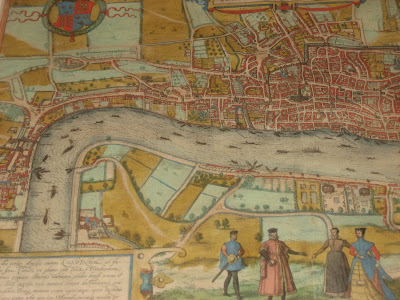


Clare, the library Deputy Head, greets and then ushers us into the catalog and search room. It's like a blip through time; the libraries we've seen thus far have been typically (a) very old or (b) very modern. The Shakespeare Centre Library and Archive seems to have caught somewhere in between, a slight 1970s snag. (You guys, the fake wood paneling! It's like a missing episode of The Brady Bunch, British-style.) But it's nice and neat and orderly -- everything a library should be. I like it immediately, especially being seated at a computer desk to write on (and later browse their OPAC with).

Clare gives us a few facts and figures about the library: They are a deposit library for the Royal Shakespeare Company, collecting all materials related. The collection is much older, of course, with pre-1700 books up until modern day. They take care to say that they do not collect everything Shakespeare -- staffing consists of only a dozen librarians, library assistants, subject specialists, and importantly, volunteers (i.e. who help a great deal in creating databases, conservation work, and in the case of an ex-theater director, gifts of excellent costumes and props). But they aim to be of use to their community and to do justice as the library of Shakespeare's birthplace; as such, their holdings number 50,000 books and thousands of supplemental items (maps, articles, et al).

The library user base is relatively small, about 3,000 people come to visit the Shakespeare Centre Library and Archive (heretofore referred to as SCLA -- for my sake, thank you) every year. These literary pilgrims arrive for a variety of reasons, some to research family history, others to consider property values, and some are very young -- school groups regularly come to map Stratford geography and history (i.e. streets, shops), to see how changes have happened over time. Most contact is made however not in person, but virtually, through phone and (more in recent years) email.

For those that do make the trek to Stratford, use of the reading room is fairly standard: pencils only, weights (not elbows) for page turning, gloves when touching photographs, et al. To preserve the original materials, readers are granted access solely to copies -- unless, of course, you are budding library students. Then you are given the VIP treatment, rolling out the shag rug, the whole shebang: viewing first editions, photographing them, swooning in due form, and then bragging about it in a terrible fashion to any who will (or will not) listen. Can you say, special? (Also: going to my head?)

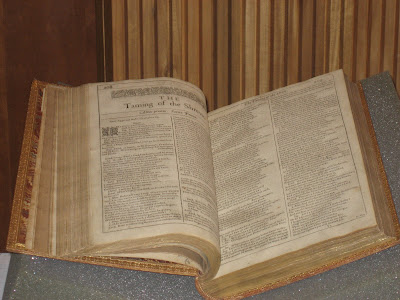
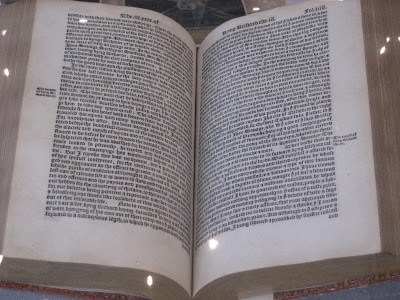
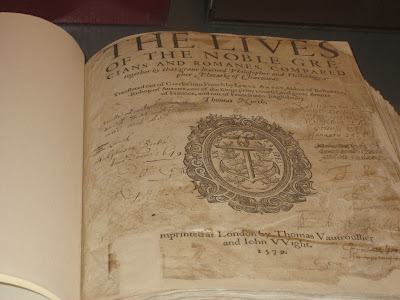
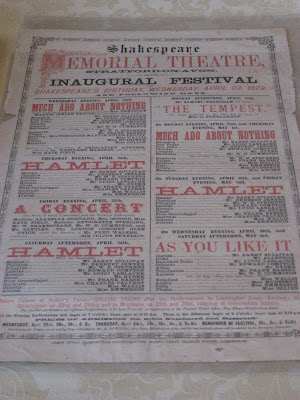
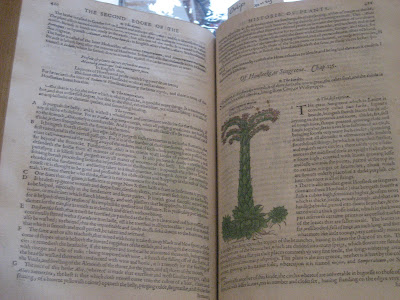
It is with great anticipation that we meet with Jo, a user services librarian, who in turn shows us into a meeting room where she's set up a table of treasures. We learn that the oldest book on display is from 1550, that Plutarch was Shakespeare's reputed source on ancient myths. We learn of herbals and of a bestiary and are shown pictures of Shakespeare's productions from the 1800s to more recent affairs (i.e. just how much stage make-up Richard Burton uses, no longer a mystery). It's mind-blowing, more so when Jo brings out Shakespeare's first folio. As in: Shakespeare. His first folio.

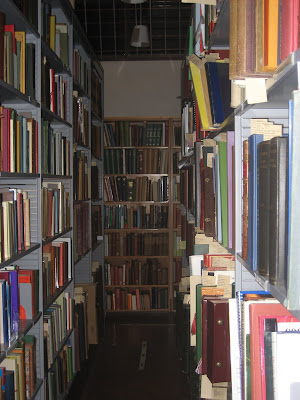
The rest of the afternoon is a fog, a euphoric fog, but a fog nonetheless. Jo continues her streak of wonderful and brings us to view the archives, the video archive in particular, but my heart is too full to process the other collections, to do them justice. Even the rain can't bring me down. Even the folks puking in the gardens. I apologize for my inarticulacy -- if that is even an actual word -- but there you have it. I humbly submit pictorial evidence instead.



Resources:
The Shakespeare Centre Library and Archive

Thursday, 17 July 2008

Site 9: The Bodleian Library

July 17, 2008


I feel as if I should start off with a grand statement because the Bodleian Library, it's like The Big One. The one I've heard most about from my professors, quoted in movies and film, and it's at Oxford University, for heaven's sake. The stakes are set sky high.

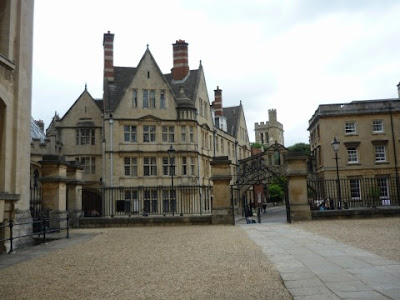
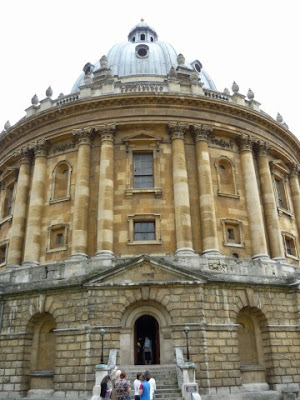
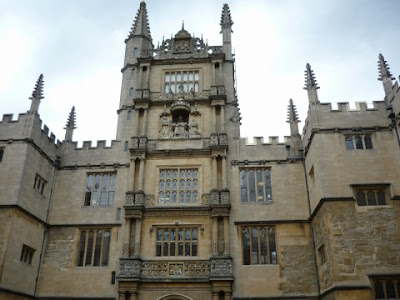
But I must cave into the pressure. I have no words, none besides, the Bodleian is all that -- if only I had a good idea as to where I was at any given time during my tour. To put it not very eloquently: the Bodleian Library is a big place. Our librarian/docent for the day is one Mr. Cross. He looks to be of a certain age, but let me tell you, he could probably take me in a foot race. In his three-piece suit, even. Part of the reason is that he's climbing through this maze called the Bodleian day in and day out.


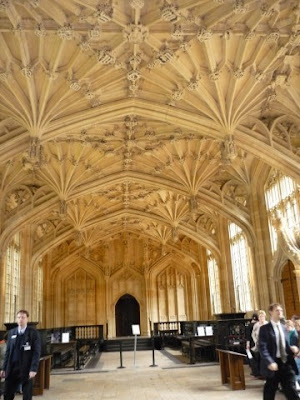
We start off level enough, though. As we make our journey just inside the reading room, Mr. Cross enlightens us further on the history of the Duke Humfrey's Library, the main research library for manuscripts and early printing. (It is in fact the oldest reading room within the greater Bodleian library complex, and according to the official website: "the principal reading room for those studying Medieval and early-Modern manuscripts and Papyri, pre-1641, special and rare book collections, and codicological, bibliographical and local history.") I am pretty impressed on sight and smell alone (old books, they kill me -- in a good way).

The Duke, as the library is named after, donated his collection of 281 manuscripts and classical texts in the middle 1400s; such as large gift called for a greater space to house them, and work began to construct the Divinity School. It opened... some time later, as most university-funded projects do. It should also be said that Oxford University at this time was not a school with deep pockets in terms of money; the Reformation and the creation of the Church of England split the country in half religiously, politically, and with these drastic changes, the university suffered both in its prestige and actual educational capacity. Anything papal was in the midst of being destroyed, and the Duke Humfrey's library, having such early promise, by 1450 was nearly empty. The library had to resort to various means for funds, such as the selling of its property -- desks, chairs, and the like. Still, these sorts of measures could hardly have raised enough revenue to maintain let alone develop their library collections.

Enter Sir Thomas Bodley in the late 1500s: a rich and educated gentleman, Bodley was more to the point, a philanthropist. He donated money to restore the old library, as well as books from his own collection and other donors -- 2,500 in total. Samples of the books still exist today, their pages made of cloth or rags.


The first printed catalog came out in 1605, the contents of each bookcase written on a notice board; and looking at the books themselves, lining the shelves 400 years later, it's curious to wonder how much, or how little has changed. A famous story, one that Mr. Cross tells us now, concerns the King at the time, Charles I. Duke Humfrey's library, among others at the Bodleian, was not a lending library -- a tradition that persists to this day. Charles I, on a visit to the university, wished for little bedtime reading and sent someone to fetch him a book from the library. Unfortunately enough for him, being King of England did not curry him any favor with the university librarians, and the rules applied to him as well. (Librarians: tough cookies to crack.)

For centuries, the Bodleian library was a chained library, in fact; storage was backwards, the book spines facing the wall (the only way to attach chains to the books). The beginning of the 19th century allowed for the chains to be taken off, and the books righted spine-wise. Today there are two stories of reading rooms going around, forming a quadrangle. And below, there are seven stories sweeping downwards of book and manuscript storage.

Which leads us to our present predicament, following/chasing after Mr. Cross into the bowels of the Bodleian Library. It's like Willy Wonka's chocolate factory for librarians, passages going here and there, machines whirring, library assistants blinking curiously as we pass -- and of course books, millions of books. To access any of Bodleian's materials, patrons use request forms, which are sent and put through tubes, where those librarians and library assistants below go on a search to retrive them, sending the selected items up on a conveyor belt. (Of course, for access to rarer sources, readers need to put up good reasons and recommendations.) It's pretty freaking neat.

We ask about digitization in terms of promoting access, and work is being done (although, to compare perhaps unfairly, not nearly to the extent as in the U.S.). What to keep, what to reformat, what type of formatting -- these are all questions which pertain to libraries, whichever the specialization. For the Bodleian Library, since 1610 they have been in negotiations with legal guilds, and anything published by the guilds is given free of charge to the library -- in addition to a number of other titles selected. Curators then have one week to sort through the incoming materials, deciding whether to weed (British terminology!), keep, distribute to other libraries, and so forth. Needless to say, it's a huge responsibility. How do they begin to predict what will have literary worth come ten, twenty, hundreds of years from now? A blunder that keeps librarians humble here concerns perhaps the greatest playwright of all, one William Shakespeare. The Bodleian had in its possession a copy of the first folio (1632) and for whatever reason resolved that it was not worth saving. More than that, it was sold for a mere £24. (Amazing. I can only hope to be at such a book sale one day.)

It's a sobering thought, and easier to say in retrospect: how could this happen? But these things do, and we're not perfect in practice. The Bodleian isn't the British Library, mind, preserving all materials in the country, but its aspirations are not small by any means. While it isn't possible to predict the next Shakespeare (if any such comparison can be made), the Bodleian, being one of the most esteemed libraries in the world, has come far these past 400 hundred years -- with luck and perseverance, but never by accident.


Resources:
The Bodleian Library homepage
Images courtesy of Dr. Teresa Welsh

Site 8: National Maritime Museum Library

July 16, 2008


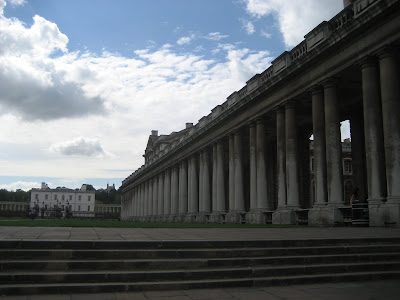
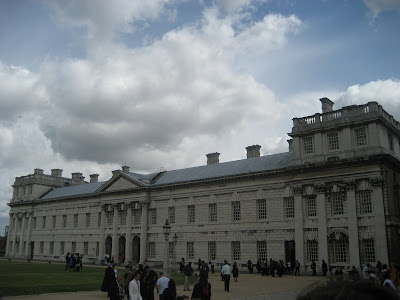
(To Greenwich, by water...)


(... and on foot!)

I have to confess that I wasn't totally on board with the idea of visiting a maritime library -- initially, that is. It's my old bias against boats, or the connection really to fishing, which I have only hard feelings for (long story short: it's boring). Well. I have another confession to make, and it came upon me very quickly after entering the museum, and up to just outside the library doors. Maritime history is far, far from boring, and I've changed my opinion about boats in general -- for the better. Walking past ship design via actual ships parked in hallways, and displays on naval fashion (hot or not?), and a really cool display of ocean liners through history, I've come to appreciate the varied facets "maritime" encompasses. And so thank you, National Maritime Museum. You've shattered all of my biases, and I haven't even set foot inside the library yet.


Hannah, the Caird Library Achive and Manuscripts Manager, gathers us around on chairs and bean bags in the e-library. Behind us are computer stations where visitors are able to search the library catalog, without having to register for reading room access. In our circle, Hannah gives us a general description of the library, but asks that we don't start off with the hard-hitting questions just yet -- it's only her third month on the job:

The library, founded and funded (the two, naturally, go hand in hand) by Sir James Caird, opened in 1937. It's presently the largest research library on maritime history, touching on emigration/immigration, migration, piracy, astronomy, shipping records and wrecks, and the Royal Navy, among others. (There's a book, actually, in print called Ships and Stars that relates in greater depth the history of the museum, but is strangely not in the gift shop. Yet.) With so much subject area to cover, the collection is huge: over 100,000 books (modern titles being 1950 and on), 20,000 pamphlets (partly cataloged), 20,000 bound periodicals (200 current titles, i.e. Mariner's Mirror), and 8,000 rare books (1474-1850). The working collection is post-1850; any request for earlier materials must be given two weeks notice in order to retrieve from the library's stores. Making sense of this library working through a museum concept (the blur for me started at the V&A/National Art Library), there are a few fuzzy areas in terms of collection development that Hannah clears up, much to my relief: paper and 2D items go in the library, 3D in the museum. How succinct can you get? Nice.

Thanks in part to recent funding (notably, the Heritage Luxury Funding donated a whopping £35 million), new renovations on the reading room have been made. Still, the library is far from any state of decay. The rotunda for example, connecting the e-library to the reading room, is a serene, light-filled space, designed by Sir Edward Lutchins, of New Delhi fame. Its original oak fittings from the 1930s are as solid, rich, and warm a color as ever.

But pushing forth. To register for the reading room, visitors go through similar procedures as previous libraries: signing forms, producing ID, and working under the expectation that prior research is called for. Not to feel thrown to the academic wolves, however, the librarians on staff are there to assist readers, and are highly qualified to do so: all are professional librarians or archivists, many being subject specialists, and they work to form teams of six. By all accounts, the staff is kept busy; 3,000-4,000 people visit the library every year, viewing roughly 2,000 books and 5,000 manuscripts. That is, to state the obvious, a lot of material to collect.

We meet two such eager and knowledgable librarians: Mike, of the manuscripts team, and Renee, a rare book librarian. I enjoy their presentations tenfold before they've even uttered a word when they both give us photocopied notes on the items we're about to see. It's crazy how much nicer it is writing up my blog without having to decipher my notes, tracking down just what my weird spellings of English names could mean, and in what context (I still don't know who Foster/Forster/Forrester is, only that he was a friend of Dickens, which is pretty sad for his sake).

Splitting our class in half, I get to hear Mike's spiel first, and many of the books are fascinating, both in content and construction. According to my (yay) type-written notes, we are looking at firsthand accounts of sea captains. I don't know why I should be constantly amazed by how neat and beautiful people used to write, but I am. And the pictures! Having to record not only numbers and figures, but of the ship, and places and people seen, sea captains were trained artists. Their illustrations, often colored, are insanely beautiful.

Mike then introduces pirates (!!! -- which always require excessive punctuation). It's just as interesting to go over their accounts, and the line tread by honest and dishonest sea-faring ways: so fine, it's often cast overboard. Seriously, and not always by choice. For Captain Kidd, his actions were fully supported by a good number of public officials... until they lost their seats the following term. And Kidd, docking his ship none the wiser (or foolishly, if he was), lost his head for it.

But the resourcefulness of sailors is outside of all moral judgment. Such a quality is put to great use in terms of books. Books with pages made of sails, books with musket balls sewn into their spines -- to be thrown overboard in the worst case scenario. The things men contrive having spent months at sea.

Switching gears slightly, Renee has similar treasures in store for us: another great set of journals, and also grammar books for sea men, and children's books on navigation. The information is all in the context, it would seem; it's debatable among scholars how much we can derive from personal accounts, as drawings are not the same as photographs, and written opinions even further removed. What do we make of the slave trade through a sea captain's eyes, the dress and manners of foreign peoples? How are we to draw lines as what truths, or half-truths to accept -- and what to reject? Everything is understood to be through a certain lens.

But on a basic level, there is the construction of books as a science. Types of bindings and printings; the colored print, with gild layering on top, is an especially beautiful technique. Patterns and woodblocks and fabrics being imported from all over the world. Who better to try them out than the men who were transporting them?

[To read more from the other side of the river (where the grass is, no doubt, greener), check out the Caird Library blog.]

Resources:
The Caird Library at the National Maritime Museum
Library Collections Online
Library and Manuscripts Catalogue

Tuesday, 15 July 2008

Site 7: National Art Gallery Library

July 15, 2008

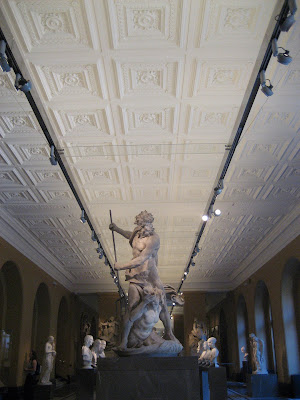
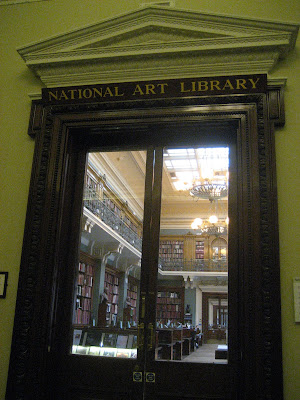
I haven't mentioned it here in this blog (for shame), but London museums rock in a number of ways that I can count: (a) many of them, especially the larger ones, are free -- a strange concept, having been hardened against that word in all cases save for "Winona" -- and (b) they are just a few tube stops away. The National Art Library, housed in the Victoria & Albert Museum, takes that awesomeness one step further and has their entrance connect to the tube. As in, you never have to leave your snug, exhaust-filled hole for the light of day. Ah, how's that for convenience?

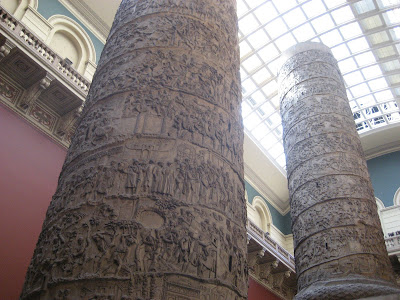
Situational excellence aside, the museum itself is great in its own right. I haven't an artistic bone in my body (attaining my fine arts credit in college was a series of unfortunate events, all of them involving charcoal, except that one time in sanguine), but I know enough to appreciate those who do. Walking through the entrance hall filled with huge, marble sculptures, I'm thankful to have arrived at the library staircase in one piece. There was a lot of gawking on my part. And plaque reading. But mostly gawking.


Our guide for the National Art Library is Frances. She's brisk, and it's a trait she sticks to for the remainder of our tour -- which is not to say it's a failing, per se, but certainly a challenge for my less-than-nimble fingers. I'm up for it -- I hope.


Upon entering the reading room, we are thankfully allowed in our backpacks (mine is well over the limit and roughly the size of a small farm animal). Frances gives us the library run-down as we hurry by different centers, on our left, counter service (3-5 staff members), on our right, the enquiry desk (visitors are able to register for 3 years or 3 months -- a curiously wide gap). We likewise hurry by other places of interest, such as special collections (where they have a day book to sign in and out members), a camera stand (for books before 1930, journals before 1900), and librarians doing things that are no doubt Important and requiring Deep Concentration (I presume for the best). And then we're whooshed through to the Marshalling Area.


It's not as exciting as the name implies, unfortunately. Basically, it means that the materials placed here are closed access, apart from reference items. Users can request up to six items at a time (searchable through the online catalogue, organized by Dewey). Librarians deliver the materials to individual seat humbers, which users pick up upon arrival in the reading room. I do like this part, similar to eating in a diner, only this time it's feasting on books. And it seems to be a system that works: it's been in place since 1899.

One of the perks of being a staff member in the National Art Library, in addition to handling such beautiful books, is the ability to borrow them. From the general collection, the terms of borrowing are in-house; staff are allowed to check out up to twenty items, "keeping" any for up to three months. I'm not sure how meaningful this type of lending would be for me in theory, especially as patrons can still borrow a librarian's borrowed titles, but it's for the betterment of the collection -- that most everything stays put. Fortunately, there is a light at the end of this lending tunnel: in the staff area, titles are available that librarians can borrow in the traditional sense.

The staff area is also home to the acquisitions, cataloging, and art librarianship departments (as well as a cornered off break room/cubicle, which again, is a nice effort, but seemingly only in theory). As with all cataloging departments, the backlog comes with the territory, but it's a workable system; all items are accessable on the date the book arrives on the premises. The gifts and exchange network the library has set up collaborates with libraries and art galleries across the globe, and this global influence is seen further in their exhibition catalogs that date back to the 1700s. Once more, the dreaded size classification scheme comes into play (alas, the sore lack of space! But the librarians here bear their cross more than willingly), but there is further organization that I can get behind: by country, gallery, form -- then moving towards size.

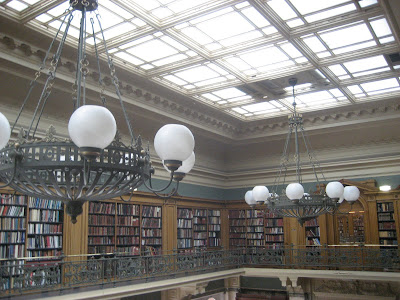
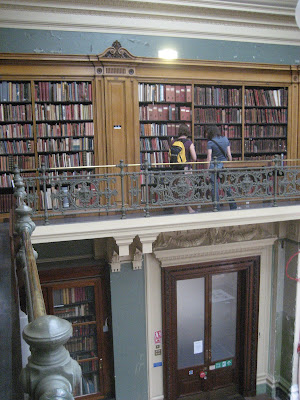
It's certainly a gorgeous library, which we are able to see to its full effect, standing now on the second floor balcony that overlooks the reading room, and next the west room, cleared out for a gallery space for a 20th century collection. Book slips are tucked between the titles that line the walls, and books themselves are tucked into every space possible (the boiler cupboards set into the shelves, for instance). Nicely enough, Frances lets us snap away with our cameras -- something not to be taken for granted, as is often the case.


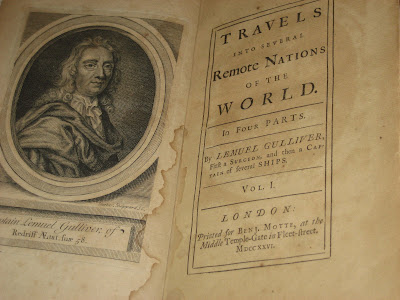
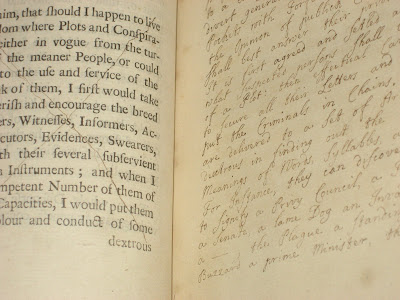
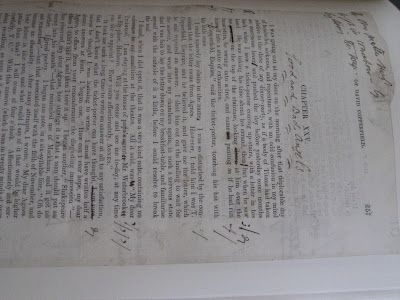
Indeed, when we're taken to our final destination, the Word and Image Department (located several hallways, flights of stairs, and oh yes, the inevitably overpriced but divine-smelling-at-this-hour café away), there are book treasures galore laid out on a long cloth-covered table. And more than simply seeing them, we're allowed to take pictures of the actual items. A part of me is pretty paranoid -- when is it not? -- but the worry here is for good reason. Before us is assortment of mind-blowing proportions, among them: illuminated letters, an annotated edition of Gulliver's Travels, David Copperfield with Dicken's own impossibly neat notes. However strong the desire is to photograph to my geeky heart's content, the librarian in me comes with her own deep-seated warnings. What kind of light damage are we doing? And why are we risking it?


I suppose I can rationalize our possible wrongdoing with the fact that this is not a public display, an everyday showing. It's both gratifying and humbling to be trusted with such rare materials, but all the while knowing that they will remain long after I've left this world. And it's not such a maudlin sentiment, really. I find a lot of comfort in knowing that these places of learning, if not the libraries themselves (alas), but the drive behind preserving our past in books and ephemera, these feelings will sustain. Whether they be in smaller collections, gallery spaces -- or museums, found at the end of tunnels.

Resources:
The National Art Library homepage

Site 6: Museum of London

July 14, 2008


"What do you think of when you hear the word, 'prehistoric'?"

That's the question that Jon Cotton, Senior Curator in Prehistory at the Museum of London, poses to visitors. His answers run the gamut, from dinosaurs to images of cavemen (club in hand, loin cloth strategically placed), to fictional -- i.e. Fred and Wilma, as in Flintstone. Rarely do people suggest what Jon hopes, prehistory referring to a time before written records.

I must admit that when I think on the term "prehistory," I am not on Jon's wavelength, but Steven Spielberg's, unfortunately; watching Jurassic Park a million times at the age of eleven will do that. But even without the aid of Hollywood special effects circa 1993, dinosaurs have been linked to the very idea of prehistoric. And it's arrogant to think so, I know, but I hold these thoughts nonetheless -- history has always seemed to begin with us. As a human concept.

Even Jon concedes, however, that prehistory is a relative definition. It depends on where one is, in place and time, to be treated in a specific context. Ancient Egypt relied on stylistic pictography, Hieroglyphics; but for Australia, formed several hundred years later, prehistory is everything before Captain Cook. And if we are to view prehistory in the sense that written records determine history, what do we then make of places such as Hawaii and greater Polynesia, oral cultures? Did English-speaking missionaries bring, along with religion and language and a much stricter dress code -- did they bring history to these islands? There is no simple answer, neither should there be, and I'm afraid I must move past my pondering.

Back to Jon Cotton, everyone. He has much more interesting things to tell us, and it's too early in the morning for philosophy anyway.


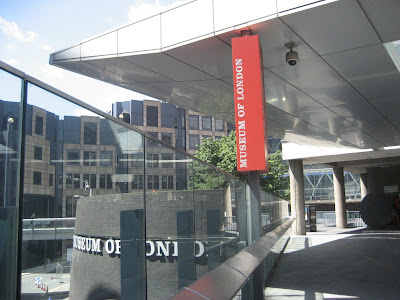
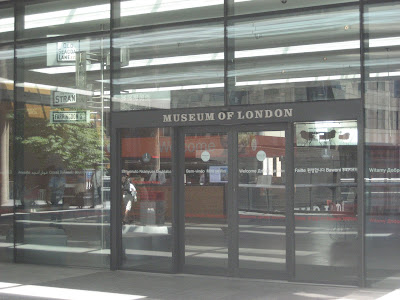
Jon greets us at the entrance to the museum, which we found our way to by walking up a staircase and crossing a bridge, leading us to a large, mirrored sign: MUSEUM OF LONDON. (I am highly gratified by very large signage, something I've never stopped to appreciate before, and something which the British appear to despise.) It's clear at first glance that the Museum of London is the most modernly designed building we've seen so far -- "modern" being determined by the fact that it's made of glass and clean lines and no plaques stating its Tudor/Georgian/Victorian origins (I'm no architecture buff, it's no secret). Inside, we're ushered into the Learning Room, where a PowerPoint presentation is at the ready.

After spending the past week breathing in the dust of ancient tomes, it's a bit weird to be back at a "regular" lecture. But easier on my feet, certainly. Jon's lecture isn't my typical presentation, however, and he is different from every other scheduled guide -- in the fact that he is not a librarian, and he is not showing us a library collection. As the senior prehistory curator, he's learned more than a few things about museums; and we as budding librarians, aren't so far removed from what knowledge he has to impart.

Most visitors, Jon begins, are interested in three time periods: Roman London, Tudor/Stuart London, and Victorian London. Curiously enough, prehistory hasn't cracked the top three, maybe even five, but Jon has plans to change people's perceptions, one exhibition case at a time. He wants to replace the "caveman image" with something more positive, something tangible, and perhaps, something even accurate.

We're shown an image of a man. He has a lot of facial hair and anguish going on. But apart from a few suspicious facts we're privy to, like that he's been frozen for 5,000 plus years, he could easily have been mistaken for a mountaineer within the last century, his frustration born out of having run out of trail mix. The caveman image, that indeterminate time between creeping out of the primordial sludge and drinking it in the form of corporate coffee, isn't so pronounced. This man could be anyone, from any time. He's had his battles, to be sure; the tools found with him, as well as the five types of blood found on him, oh, and the arrow struck in his back -- these give a greater, if still mysterious, backstory. Prehistory isn't so hard to picture when we can see it, and come to think of prehistoric peoples as individuals.

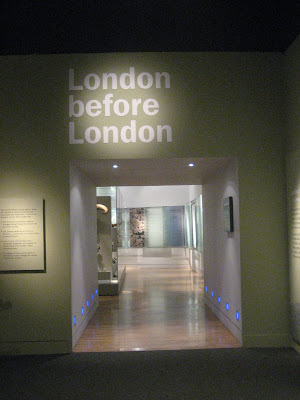
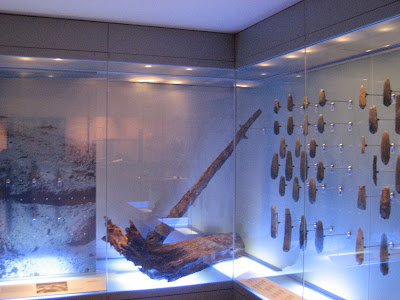
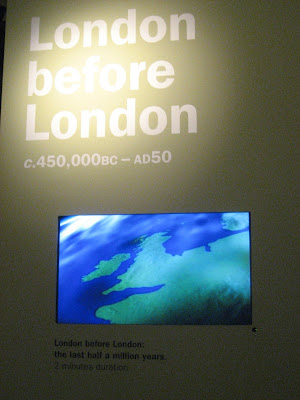
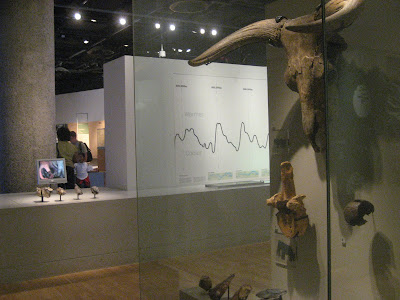
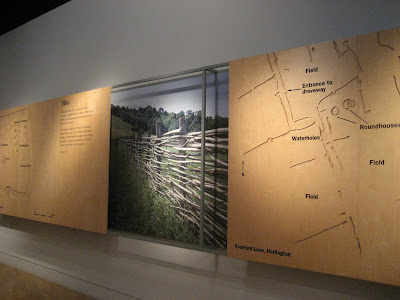
Putting history out there on a personal level is what Jon sets out to do, especially in his exhibit "London Before London." On the upper level gallery (the ground level being closed for renovation -- swiftly eliminating the Tudor/Stuart competition! Oh, and for the good of the museum, I suppose), Jon takes us to the start of story. We've seen the PowerPoint on it: the Museum of London, having grown from a private museum attached to Kensington Palace, then moved to Guildhall Museum for the city of London itself, finally standing in the city for which it holds its history. The museum houses London's history as well as prehistory -- half of a million years of human activity before the Romans even set foot ashore.

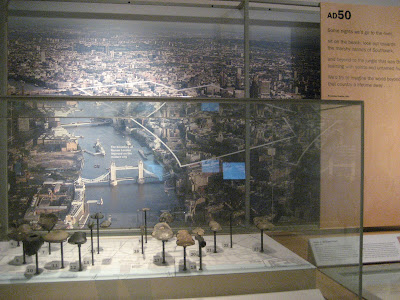
The Thames River, more than a natural landmark, is and has always been London's defining trait. Used for travel, for sustenance, for religion, for political intrigue or fashion, the Thames stands as evidence of the power of place. The effect landscape has on the way people organize themselves as a society. Using the Thames as a running theme in the exhibit is such a perfect creative move, it seems the only choice that could be made. (This is one of those times that, in the face of something so right, any trace of coherent articulation leaves me. I'm just glad Jon and company are the ones in charge to think of the smart ideas.)


But -- and there almost always is a but -- ideas are one thing, and execution another; the consideration of space, and how to work with what's available, makes the need for creativity to some extent, bend to its will. The space Jon was alloted wasn't terribly large (nor was the budget), but design and organization make the finished product flow. Key pieces are chosen to display: a video at the entrance, artifacts found in the river, examples and models of dwellings, interactive stations for tool-making and quizzes, et al. Being panel-dominated, the exhibit requires visitors to do the work (i.e. read). An inventive choice was hiring a design firm which normally works for retailers. Repeating a storefront experience in a museum is a subtle piece of change, not only to transition visitors into learning, but to transform museums too, and the way they teach.


So, after all my typing, the big question remains, and it has nothing to do with prehistory (I promise). What, for all Jon Cotton's words of wisdom, does this relate to libraries? While in a different way, and dealing with different objects -- although some of them just as fragile and rare -- libraries want to share and display our collections too. We select books to recommend, we come up with themed events, we make our libraries spaces where people feel welcome to study and learn, and to appreciate. Presentation is key in very much the same vein. When we put ourselves in our patrons shoes, what do we see, what do we expect? Do we think dinosaurs -- or do we think, maybe cavemen deserve another shot?

Resources:
The Museum of London homepage
London Before London exhibit