Saturday, 12 July 2008

Site 5: The Women's Library

July 11, 2008


The entrance to the Women's Library is a bit deceiving. The directions printed from their website are very clear, no complaint there, but following them takes some suspension of belief. "So I follow this dodgy corner, down this dark alley... aha!" My paranoia-slash-innate-distrust is very much intact.

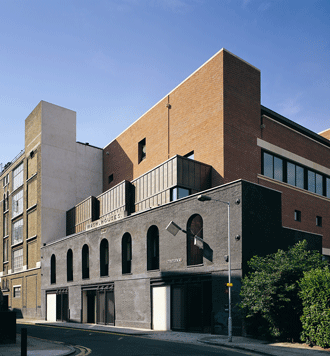
The inside of the women's library is a whole other story, which is all loveliness of brick and clean lines. The receptionist on the ground level quickly signs me up for reading access (for reference: a double sided-sheet, photo ID required to hold for the duration of visit), hands over my card, and I am good to go. Well, after a short stop downstairs wherein I store my non-reading-room-compliant backpack.

Taking the stairs to the third level, I find the reading room mostly empty, apart from the librarian, a man intently reading, and a woman fast asleep. (I suppose learning can be made, albeit at a slower rate, through osmosis.) There is a long table for research and study, open stacks wrapping their way along one side, biographical material on the other. An adjoining room houses periodicals, a line of computers connecting the two sections. It's there that I make my initial Virginia Woolf catalog searches.

I soon realize that the Women's Library is connected to London Metropolitan University, judging by several books that are housed in the college's other libraries. I do find a good number of pertinent materials, biographical and ephemera: most excitingly, Virginia Woolf's diaries, and newspaper clippings. Roaming the stacks, however, becomes my downfall, and I pick up several essays on Virginia Woolf and lose track of time down that road. Which is not such a bad road, but not as pertinent a direction as I should've taken.

I did, it should be said (as my saving grace) that I noted what titles I had need of. And so another visit is in the plans, this time with librarian staff help, for the restricted items, and other reference material they are privy to (and my own searching skills are not!).

Resources:
The Women's Library
Images courtesy of The Women's Library (London Metropolitan University)

Site 4: The Barbican Library

July 10, 2008

“A building where there is always something rich and strange going on.” The Guardian, March 2007
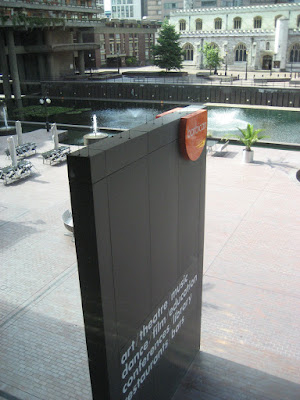


The Barbican Centre prides itself on being hip and cutting edge; and according its website, is in fact the largest multi-arts centre in Europe: featuring art, film, music, theatre, dance and education -- "all under one roof and under one creative direction." Pretty happening, man. The most happening part being, of course, that a public library is not only attached to the centre, but is indeed a valued and central element of it.
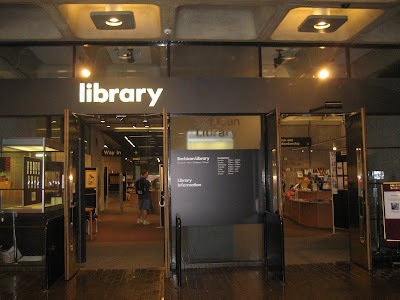


On our visit to the Barbican Library, we are met at the door by the children's librarian, Amanda. It's a bit surprising, for me at least, but an interesting change of pace; after all the glorious decrepit books we've seen, we find ourselves being lead into a room filled with low shelves, bean bag chairs, and colorful banners hanging from the ceiling. If I close my eyes and squint, I could be back in my second grade classroom. I'm almost certain that the carpeting was this very same brown-green mix, vintage 1979.
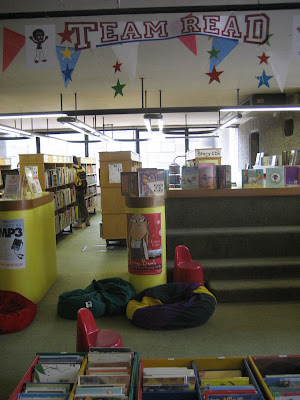


In addition to (and partly, I daresay, because of) its decor, the Barbican Library has a warm and genuinely happy air about it. These librarians are not simply going through the motions of a tour. They're proud of their small, orderly library -- and rightfully so. You know librarians are happy when they, off the record, are asked whether they are satisfied with their yearly budget and funding -- and their answer is a yes. A yes! It makes me a little sad that having enough is such a shocking revelation. This is the first time that someone, anyone, working with public funds, to outfit a community with pertinent services and materials, with national standards to maintain, has even come close to suggesting that yes, they have the means to do so. Forget the tabloids, this is way juicier news than any piece of scandal Prince Harry can cook up.

Sufficiently intrigued with what other wonders the Barbican Library has in store, we take our knee-level seats and wait our turns before speaking. A run-down of the Barbican Library's figures, facts, and perhaps a little fiction:

A good reason as to why the Barbican Library can serve the City of London as well as it does lies in that the community is so small, hovering around 9,000 people. While a bustling center for business, the city is not so much a domestic paradise. The library takes full advantage of the fact, and their programs thrive: in weekly, 30 minute blocks, the children's library holds classes for nearby schools, as well as groups for after-school and younger children. Parental supervision (outside of class) appears to be a must; when we asked of censorship and borrowing privileges (i.e. for material outside of the age range/children's section, expensive items [they have an ipod-loaning program for audio books!]), Amanda assured us that "they had a talking to with their parents first." I'm not quite so sure how that would hold up in the States, issues of privacy, intellectual freedom coming to surface, but it is very like a small community in this character -- that sooner or later, everyone's business becomes public knowledge.

Still, even when crossing shaky ground, the merit of their programs cannot be denied. One such great project (government-funded, even) is Book Start, which aims to equip every child with three packs of books before the age of 5. And it is not only a smart endeavor, but a successful one at that: 90% of London's children utilize the program. It seems a no-brainer that, well, when given free books -- who would be the fool not to make the most of that? But without properly advertising the service, without stocking public libraries within each county, without ensuring that the process of obtaining the packs is painless (and how many government projects can boast of that?) -- the public will not jump through hoops. And to my own jaded mind, I would suspect, what's the catch? Thankfully, the City of London is of a more hopeful nature, and the Barbican Children's Library a resource that does not disappoint.

A greater depth of children's programming in libraries is accounted (which, to save time and possibly... interest, I will only divulge upon demand), and we adjourn finally for biscuits and tea. A huge gold star for the Barbican Library! (My devotion is easily bought.)
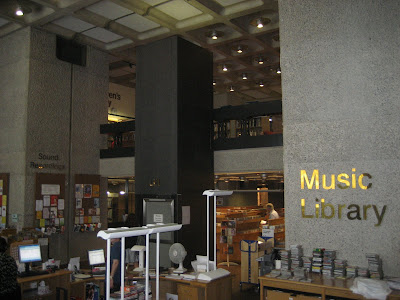


Upon our return, we head to the Music Library, our librarian guide here one Liz Wells. Her information is of the impressive, if oddly phrased variety: Barbican's Music Library is one of two of the largest music libraries in London (which I assume means it's number two. No shame in that, Barbican!). It's especially impressive when we consider that it basically started from scratch in the 1980s. One of the first sights, standing evidence of the library's Second-is-the-best status, is its CD collection, 16,500+ items strong. Organized by genre, then by single artist or performer/group, the CD collection is a great resource for music lovers (and by making its genre categories relatively broad, remits them from arguments with ardent fans). Given the popularity of mp3/mp4 formats and online music venues, the demand for CDs has as a result dropped in recent years. To meet the changing needs of its users, the library has made efforts to promote online music databases and services (such as Oxford Music Online and Grove Music Online). The response, Liz is excited to say, has been "quite good."
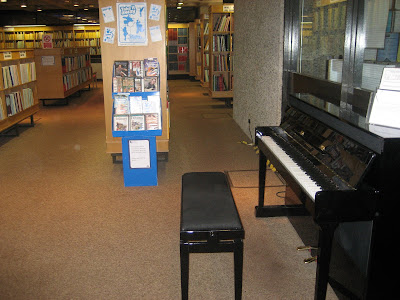


The most noticeable (and arguably, most awesome) feature of the Music Library, however, has to be the electric piano near the entrance doors. Users are able to test out musical pieces to see if it is to their liking, and I love that this level of access is available. Library patrons are obviously in love too, as Liz informs us that the piano is booked (one hour slots per day) from opening to closing. Most people use it for general practice rather than to take a stab at the library's sheet music, though, and I'm reminded of my own library's public computers, and how they are meant for research, but really, I have my suspicions that they are personal offices for more than a few.

The collection of sheet music goes beyond the piano, of course, and is cataloged by arrangement (i.e. vocal: single, duets, choral, chamber, and so forth). Unlike the CD collection, which relies on user statistics to weed out unpopular items (and it is here that we are sadly informed that a huge music fundraiser goes on every January! Prices are slashed so low the exchange rate is only midly painful!) -- the sheet music selection saves its pieces for archival purposes. As much of the print music is no longer being printed, the library often has in its possession a rare copy of certain pieces.

After oohing and aahing for some time, I finally notice that it is strangely quiet for a music library, the only sounds coming from, well, us. Passing listening centers that are headphone-compliant, and the aforementioned headphone-compliant electric keyboard, I remember that we are in fact still in a library, which is attached to other library sections; and while sounds must and do travel from other parts of the Barbican Centre, having a musical extravaganza would probably be pushing the button too far. But with everything in the library circulating, save for periodicals and reference material, people are free to make as much noise as they like at home (with the consideration of their neighbors in mind, with all due hope).

Still, as with any library, improvements to be made are always on the horizon. One such area in the music library is the DVD loans, which are on the pricey side £2.75/week -- nothing on Netflix, to be sure. And the act of loaning materials, print or electronic, comes with it copyright concerns. Such infringement can be easily spotted and snipped in the bud while in the library, but librarians cannot control what people do in their own homes (although the frequent signs everywhere -- and I mean everywhere -- proclaiming that CCTV is in play has me wondering). I can't help but question whether in the future the turn-your-head-and-look-the-other-way approach is going to pass muster. Are we to be responsible for our patrons actions, as mediums between them and others' intellectual property?

On a less paranoid note, the library itself is anything but Big Brother-esque, no iron fists in sight. We are still in the Barbican Centre, after all, it of the artsy-fartsy persuasion.

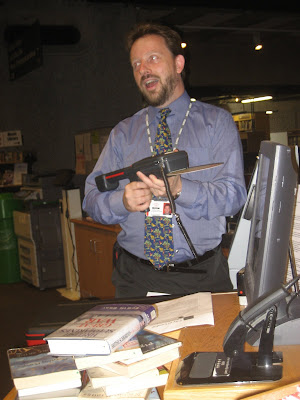
Venturing out into the main library, the adult section, we meet briefly with Jonathan, the IT librarian. This is another nice surprise, as we were only scheduled to see the Children's and Music Libraries. Jonathan gives us a whirlwind tour of the adult library: low shelves for easy access, art and book displays for suggested reading (by interest topic, age range, among others), the convenience of having a circulation counter as well as self-checkout stations. But he is most enthusiastic, it is certain, about one thing: RIFD technology. The first reader he shows us is a well-oiled machine of awesome, able to read twelve items (seen to believe it) in one fell swoop. The second reader he shows us is possibly the geekiest device ever made, which of course made it cool. Shaped like a machine-gun with a RIFD wand at the end, it's intent is to be mobile when reading tags. It's such the epitome of geek cool that it's a crying shame that it doesn't work.

But one day! Librarians will be armed and ready.


Resources:
The Barbican Centre homepage
The Barbican Library

Site 3: The Poetry Library

July 9, 2008


The Poetry Library is situated a stone throw away from King's College, at the Southbank Centre, and the close vicinity was a good option (for me and my misguided sense of direction, that is) for two key reasons: (a) it was raining and (b) it was raining really hard. One day, I will stop whining about the rain, since it is England, and all that downpour is probably why poems about rolling hills and English roses were written. But today, I am sorry to say, is not that day.

Since this is my first independent research day, I am armed with three different maps of various sizes and degrees of helpfulness. I manage to right myself, but I show up much too early and the library hasn't opened yet. My main problem, however, soon becomes clear when I return an hour later from the Queen's Walk; I did not anticipate the grand opening, or exclusive invite-only celebration, of Mark & Spenser's in the Royal Theater Hall, the very same building which houses the Poetry Library.

I'll try not to go too far into my trials and tribulations (your welcome), but this is how the saga unfolds: I walk around the building, once, twice, an embarrassing, stalker-esque number of times. I ask one, two, an annoying amount of security guards as to which entrance I go through to get to the Poetry Library. The answer: the next one. Which must be a lie after I've circled the perimeter. I read a sign that tells me to go to the entrance near the glass lift to enter the Poetry Library and security will escort me up. It's really quite mind-boggling at this point. I had no idea that a grocery store opening was such a hot ticket.

The most, if only helpful (although the security people were all very nice) advice was given to me by the not-as-nice store clerk opposite the Hall. The glass lift, as it turns out, was hidden behind the mobs of lined up people, and it made me feel rather important if ridiculous, ducking behind the velvet rope in front of everyone to go to the Poetry Library. With a suit-and-tie escort, no less.

Once inside, I give my thanks to whatever gods came to my rescue, and park myself in front of the first welcoming spot: the computer. Here, I orient myself with their databases. Through the library itself, users are granted access to three online databases: Chadwyck-Healey Literature Collections, The Columbia Grangers World of Poetry Online, and Litfinder; although usernames and passwords were provided on a laminated sheet attached to the monitor, I was only able to gain access to the first mentioned.

Browsing Chadwyck-Healey, I read through their about section (they aim to make available literary canon as well as lesser known contemporaries -- all in e-format) and have some hopes as to finding relevant materials for my research subject, Virginia Woolf. I perform a few test searches, and do find books by Woolf, but none really with biographical information. I decide to try my hand at the shelves.

While it is not my intent to focus on Woolf's poetry, I do like that I am in a public library with open shelf access; it's a freedom, really, that I'd taken for granted. I take my time walking through the stacks, taking stock of the building for the first time.

It's a small space to work in, only part of the fifth floor (I can't judge how large a part, I'm afraid, outside the library being Suits everywhere, inhibiting my freedom to wander). It's a small space, but warm and quiet -- a good feature, considering that the windows face Waterloo Road. Reference makes up roughly half of their stacks, with lending items making up the rest. Periodicals and journals line the shelves, but are reference material, so no lending on that front. There are pamphlets and brochures advertising poetry events, contests, workshops, readings, and so forth -- but no official Poetry Library guide, which is a little disappointing. But their website proves to be much more enlightening.

The poetry library homepage is beautifully and simply designed (my favorite web combination): with a lot of white space and tab links that take you exactly where you expect to go (i.e. About Us, Poetry Queries, Events, et al). Some history on the library: founded in 1953 by the Arts Council, the Poetry Library moved into its present building in 1988. The collection prides itself on being the "most comprehensive and accessible collection of poetry from 1912 in Britain" -- well worth such bragging rights, I'd say. What variety of formats available is also noteworthy, with print, audio-visual, as well as ephemera, among other media. The stand-out feature, though, is the exhibition space for artists and writers, which is very key, I think in engaging readers in real time, with real people. Working so much from a distance with reading material, it's a whole other experience to see it performed, and to speak with performers -- to interact on several levels.

The remainder of library information on background and content is pretty standard for libraries: providing service, access, acquisition, and promotion. Which is not to brush over these qualities, nor to make light of them, rather to make the connection, that public lending libraries, no matter the specialization, have much of the same aims as their traditional counterparts.

Having gathered my thoughts somewhat, for my next visit, I am hoping to speak to a librarian. That, as well as keeping my fingers, toes, or what have you, crossed -- hoping against hope that the weather takes pity on me, and that other grocery chains set their sights on the other side of the river.

Resources:
The Poetry Library
Images courtesy of The Poetry Library at Southbank Centre

Tuesday, 8 July 2008

Site 2: The British Library

July 8, 2008


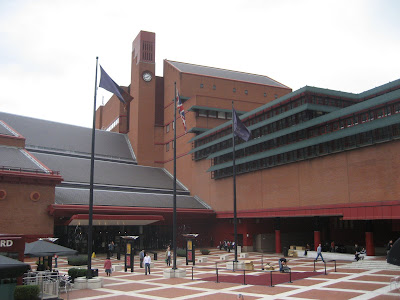
The British Library is a short walk from three underground stations (short walks always being a big, fat plus, in my opinion. At least where a chance of rain is concerned -- and I am very concerned!), and it's a delight leading up to the entrance doors, strolling through the piazza completely dry. The grounds are quiet when we first arrive, not yet ten o'clock in the morning (but given the bhangra music which later permeates, however, the action soon picks up in the afternoon). Inside the library is a different story: the foyer, the staircase leading down into the cloakroom, the staircases leading up to rooms yet unknown -- it is a fairly bustling center of action. Researchers totally abide by carpe diem.

Once inside, I make a beeline for the racks of brochures, all of which I find are of that rare and hopeful breed of being both (a) helpful and (b) really lovely to look at. Armed with the latest news of library events, tours, and introductory everything, my next beeline is to... the restrooms.

Of course, given my impeccable timing in all matters, I find that our tour guide has arrived when I return, and hurrying over, I manage to catch his position and name. The British Library's Donation's Officer, Kevin (no last name as far as I am aware, and not unlike Cher or Madonna -- which is very rock star librarian of him), starts by giving us a brief history of the library. Being a national library, the British Library is charged with three central aims: to acquire the entire bibliographic output of England and Ireland, to maintain and keep these materials forever, and to make available their collections and technology. Pretty substantial shoe-filling here. And seeing their goals through, in an on-site collection that numbers 35 million books, that takes a lot of manpower in addition to vision -- 2,300 staff, in fact.

The British Library website helps to broaden where Kevin (or my note-taking, rather) leaves off. Navigating the site with a specific designation in mind (i.e. using the online catalogue, identifying services, popular collections, et al) and for different sorts of users, whether they be for educational, business, personal, or Top Secret purposes -- is made simple by the Go To heading listed at the bottom of the page. For the fast and furious, a breakdown of the library can be found in easily digestible bites on the Quick Information page. Here, you can, well, quickly gather information on the library's holdings, usage, and the all important question -- where exactly is this library, and when can I visit it? For those homebodied souls, Quick Information also includes digital resources that users can access from the comforts of home, or internet cafe, or wherever wi-fi takes them.

Returning to my actual tour, Kevin delightfully stuffs our heads with more British Library statistics, and British humor (/humour -- Kevin seriously laments the death of the letter "u" in American spelling) in general. Some dates, if you please: In 1961, the library came into being, so to speak, separating itself from the British Museum. Original plans for the library meant to knock out several Georgian-style buildings within the museum's vicinity, but public outcry (thank you, people) put a halt to those designs. The British government eventually bought land for a new site from the railroad system, back when it was privatized; and in 1973, the British Library became its own organization. Just ten years ago, 1998 brought the library to a newly renovated structure, where it remains today.

It's hard for me to imagine such a move, relocating 20 million items. But it can be done, in 4 years actually. The groundwork of developing such vast collections began much earlier, of course; Sir Hans Sloane, one of the library's founding fathers is credited with starting the rather excellent trend of donating personal collections to the nation. (He also had a hand in encouraging his friend Cadbury to purchase chocolate from Jamaica, yet another endeavor that we can all take satisfaction in.) More than the physical giving of books, Sloane perpetuated the idea that knowledge is to be shared. The spirit of public libraries depends upon this thread, however tenuous or strong we make of it. It's a great ideal. Of course, I am equally, if not morbidly interested with the disaster contingencies plans they have in place.

Six floors beneath us is sixty percent of the library's holdings, a mixture of open space and stacks and many things that could go wrong. In the event of fire: air vents are made thin to allow for easy access for firefighters. In the event of flooding: a subterranean water systems exists, where rainwater is collected, then shifted into the River Thames. And for the sake of our ears, a 40 foot wall works to absorb sound.

However safe the stacks may hopefully be from natural disaster, we can only imagine. We do not have access to them after all, not as public users. The British Library adheres to a closed stacks policy. But with a library golden ticket, a.k.a. Reader's Pass, users are able to access the materials. Thanks to my inherent paranoia, I have with me every identification card I own (my passport, my international student ID card, my driver's license, as well as my old driver's license -- don't ask why) and course syllabus; I am totally set for yet another library card. And really, one can never have enough.

Any wistfulness on my part as to browsing is soon put out when Kevin informs us of the library's classification system. "Size," he says. At first I think he means an acronym, but no, it's all straightforward, and entirely incomprehensible. Kevin explains that they use a grid reference: location, floor, quadrant, in terms of how to find items. He then claims that, "The Library of Congress is terribly jealous," which I suppose could be true, given the space-saving, and I'm no fan of Dewey (the classification nor the man). Living on an island is hard storage-wise times, but come on, size? Seriously? Maybe it's just me, but I can't order myself as a librarian that way. For once, I am pretty happy with America's supersize ways.

However, the bigger dilemma for me, now, at this very moment, is trying to end this entry. I know -- you undoubtedly feel -- I must. But like the 800 miles of shelving which wrap around the British Library, my notes seem to have taken a similar turn, long and meandering. I haven't even got to King George III's personal book collection! Jane Austen's letters to Casssandra! Beowulf! It's impossible to fit the enormity of what the British Library holds, and what those holdings mean, not in a single blog entry. So I bite off what I can chew; and it's not the naming of parts but the possibility, really, seeking the world's knowledge, that holds true.

Resources:
The British Library homepage [official site]

Monday, 7 July 2008

Site 1: St. Paul's Cathedral Library

July 7, 2008


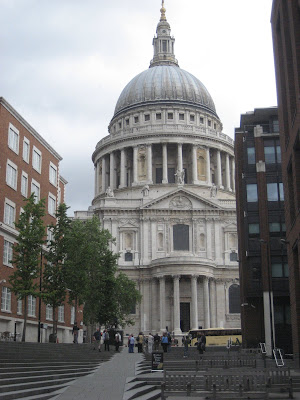
It's cool, with a light rain starting when we arrive at St. Paul's -- and a welcome site it is indeed, poor weather aside. I'd visited the site the day before for the Sunday service, and the interior of the church, with its high domes and galleries, is totally arresting. There isn't really a turn of phrase appropriate to describe the feeling of standing in such a space, seeing what men have and are capable of making, and anticipating what lies beyond.

Forming a huddle within, we await our tour guide, the cathedral's librarian, Mr. Joseph Wisdom. What little we know of him thus far comes from our first class meeting, where he was described as being very British and very proper -- a very stereotype of a librarian. This is neither to paint an unfair picture of the man, nor to say that conforming to stereotypes is necessarily bad. We must endeavor to give Mr. Wisdom the benefit of the doubt. We must.

While we -- and you, reader, as a result -- wait, here is a little history on the library [via its official site]: After near destruction at the hands of the Great Fire of 1666, St. Paul's Cathedral library underwent a rebuilding process, along with efforts made to restore the structure itself. Architect Christopher Wren was sought out (by the King, no less) to survey the cathedral for repair. The library chamber that Wren designed and built was steadily developed through the work of commissioners and patrons: the collections rooted in theology, but spanning through other related topics such as cosmogeny, civil and canonical law, science and history. Noting as much, however, we must bear in mind that subject distinction was not so firmly drawn, not in a modern sense. To be brief (and regrettably vague): theology in the sixteenth century was a different playing field. And additions to the collection came from bequests of Henry Compton, John Mangey, among others, enlarging not only the amount, but the depth of the library holdings.

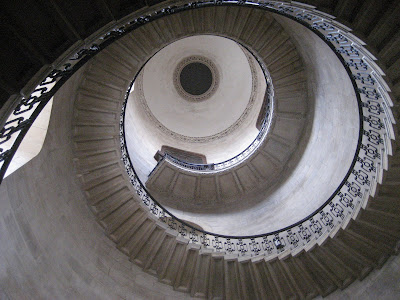
And so, with that background in mind, let us return to our tour. Mr. Joseph Wisdom appears, having, we come to discover, narrowly escaped a leaky pen incident, and guides us around the velvet ropes (the very essence of library glamour). He indicates to us a door, above which is a carving of a book -- The Good Book. Which seems appropriate, being attached to a place of worship, and Mr. Wisdom agrees -- and elaborates further in a much more articulate manner. But my attention is already caught by what lies beyond the door, the Dean's staircase.

It is an amazing twist and turn of stone, a feat that I do not truly appreciate until we begin ascending it.


Out of breath, but pretending not to be, I am grateful when Mr. Wisdom takes pity and speaks of the Reformation. The removal of statues and icons are evident when we look to empty spaces where they ought to have been placed. At the top of the staircase, we note the plain finish of the door, the basic carving on the walls as well as the floor. After the previous grandeur of the cathedral, such a humble display is striking. It slowly dawns that the triforium level was never meant for public use. The only thing that comes close to a decorative border is the latin phrase carved above: "Faciendi plures libros nullus est finis." It's from Ecclesiasticus, meaning: There is no end to the production of books.

Walking on the level now, we avoid a slight construction zone. The cathedral is undergoing continuous renovations (what historical site is not?), and as a result we make our way past pieces of a font and several pulpits. Mr. Wisdom stops to quiz us here, asking us what we presume a large stone vat is. Naturally, our minds turn macabre. "A crypt! A tomb!" we cry. Mr. Wisdom shakes his head in polite dismay, "You believe we keep dead bodies up here?" The vat, as it turns out, is a kind of water container that the church used ages ago to collect rainwater. Not quite the build up I was hoping for -- but then again, the lid never was lifted, now was it?

We are lead into a trophy room, with sketches along the walls, carvings etched into the fabric of the walls, and placed center, a gorgeous wooden model of the cathedral. We are so caught up in viewing/fawning over the model, that Mr. Wisdom's second quiz takes us (or me, I should say) by surprise. "Now," he asks, "where are the books?"

The room on first, second, third -- you anticipate the pattern -- inspection, appears empty save the previously described contents. But we look closer. Within the carvings are books, integrated so thoroughly in the design of stone that they at first seem unremarkable. Now that we have seen them, however, they are impossible to ignore, and it feels very apt that books not only support liturgy, but are a part of the structure itself.

The next room, I am sure you can guess, has me simultaneously growing impatient with and dying of curiosity. The library has its secrets, I'm certain, and as we near the foot of its door, we find the first. What could the sign taped on front, "Beware of pigeons!!!" -- what could this mean? Mr. Wisdom sheds some light in a rather sheepish fashion. "Oh, that?" he says. "You wouldn't want to hear my pigeon story." Oh, but we do. And reader, please, pardon my digression.

Being a librarian of little monetary means, Mr. Wisdom is often left with, well, all of the tasks. These include the closing up of rooms, offing lights, and so forth, before ending his workday. On one such occasion, it so happened that a pigeon snuck his way in just as Mr. Wisdom meant to leave. Instead of being cooperative and shushing out as a nice vermin should, the pigeon boldly flew up to the rafters and Mr. Wisdom, so close to going home, spent another few hours covering every possible surface with plastic sheeting.

But once we enter the library, we understand all of the caution. The walls are lined row upon row with books, broken only by a stretch of windows, and then connected again to more books. The room itself is a gorgeous bit of space, with high ceilings and low light and the smell of old books. Heaven. Mr. Wisdom agrees wholeheartedly, but gently brings us back to earth in discussing preservation concerns. Conservation is the term he uses, and close tabs are kept on the materials used to, for instance, re-back books; the environment of the books is also monitored, using a sign-in sheet every time any one leaves or enters the room. Temperature control, exposure to varying elements, these are all looked to when considering the best course of action -- or inaction to take, as may be the case. He makes the distinction that they do not restore, not in the sense that materials "are tarted up simply to look pretty."

As my brain slowly kicks into use (book spells are hard to break), I begin to wonder at the classification scheme. I am not the only one. "Size," Mr. Wisdom informs us, "that is the organization." It seems incredulous to incorporate such cataloging to my American mind, but from what I know of the British, if they are one thing they are economical. What space they have, it is put to use, and libraries are no exception.

I adore the idea that the space each book holds is as important to the collection, as the collection is to the book: every book forming a story, the overarching narrative the collection. Duplicates are treated as individual books, separate stories, and even objects found within books become part of their history. It is amazing to feel, if only for a time, the enormity of hundreds of years of printed word, the connection we have and continue to forge with our past.

Resources:
St. Paul's Cathedral Library [official site]